
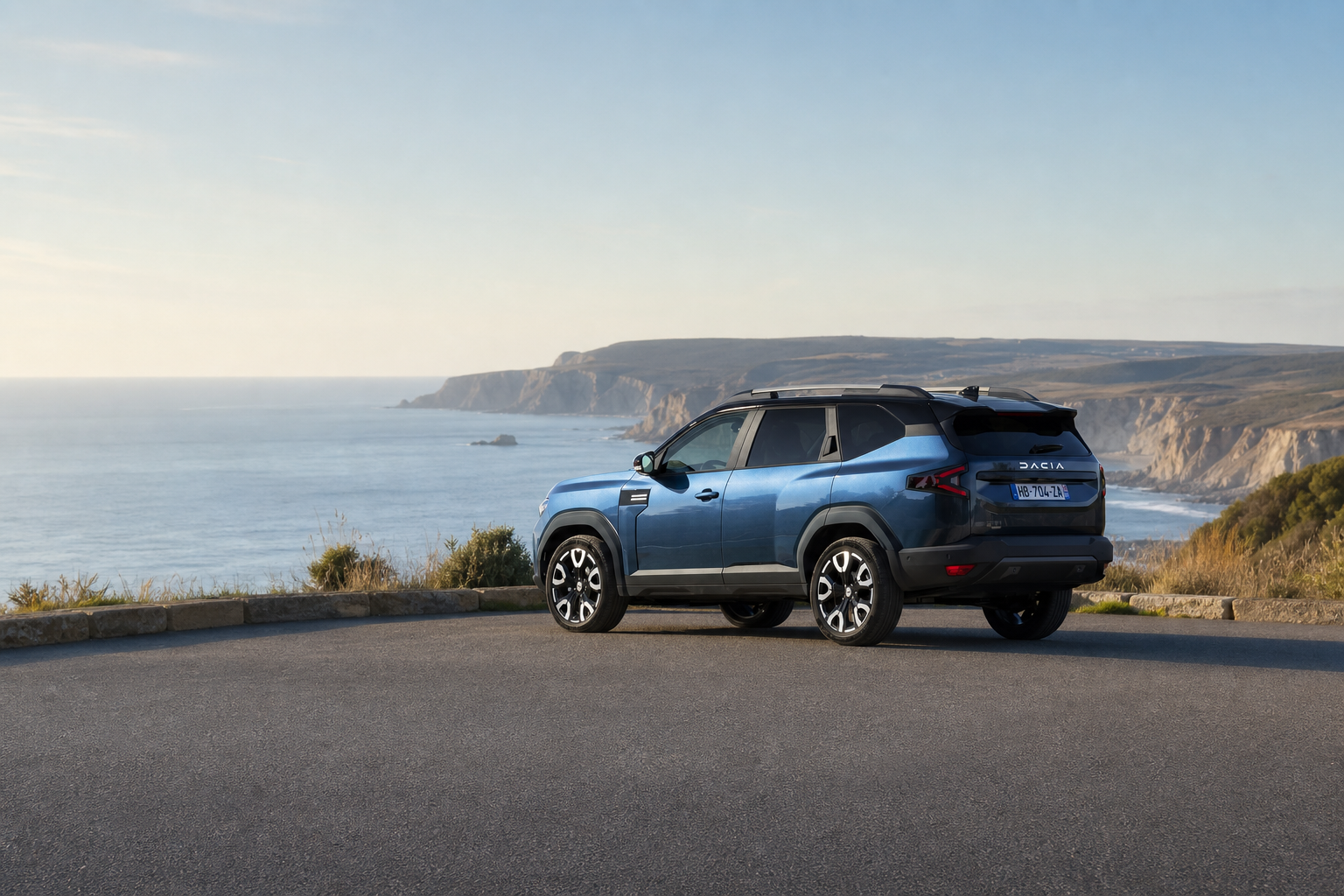
The Dacia Bigster Hybrid has featured in a new Green NCAP study of family summer road trips. The crossover is listed with a range of 847 km on a full tank—enough to cover most of an 800 km journey without stopping at a fuel station. There is an important qualification, however: this figure is calculated from fuel consumption and tank capacity, rather than measured by driving until the fuel is completely used.
Green NCAP recorded fuel consumption of 5.9 l/100 km in a long-distance trip scenario with four people, luggage, the air conditioning switched on and a predominantly highway route. With a 50-liter tank, that works out to approximately 847 km. Here is how relevant that figure is to everyday driving—and where the hybrid uses noticeably more fuel.
How Green NCAP Modelled the Family Trip
The independent organization published the results of its summer road scenario on 16 July 2026. It assesses an 800 km journey with a typical holiday load: four passengers, luggage, the air conditioning running and a significant share of motorway driving. For cars with internal-combustion engines and hybrids, the organization calculates fuel consumption and range; for electric vehicles, it also measures the charging time required along the way.
The tested Bigster was the front-wheel-drive Journey Hybrid with an automatic transmission. This full hybrid does not need to be plugged in: its traction battery recovers energy during braking and is also supplied by the petrol engine.
847 km: A Calculation, Not a Guaranteed Range
The arithmetic is simple: 50 liters divided by 5.9 l/100 km, with the result then multiplied by 100. That gives 847.5 km. The 50-liter tank capacity for the Hybrid 155 is also listed in Dacia's official specification table.
Calculated range in the Green NCAP scenario.
The 847 km figure does not mean that every Bigster will necessarily travel that far before the fuel warning light comes on or the vehicle stops. The actual result depends on speed, temperature, terrain, tires, payload, headwinds and climate-control use. Drivers also normally refuel before the tank is completely empty, so the practical distance between stops will be shorter.
Bigster Hybrid Fuel Consumption in Town, on the Highway and in Winter
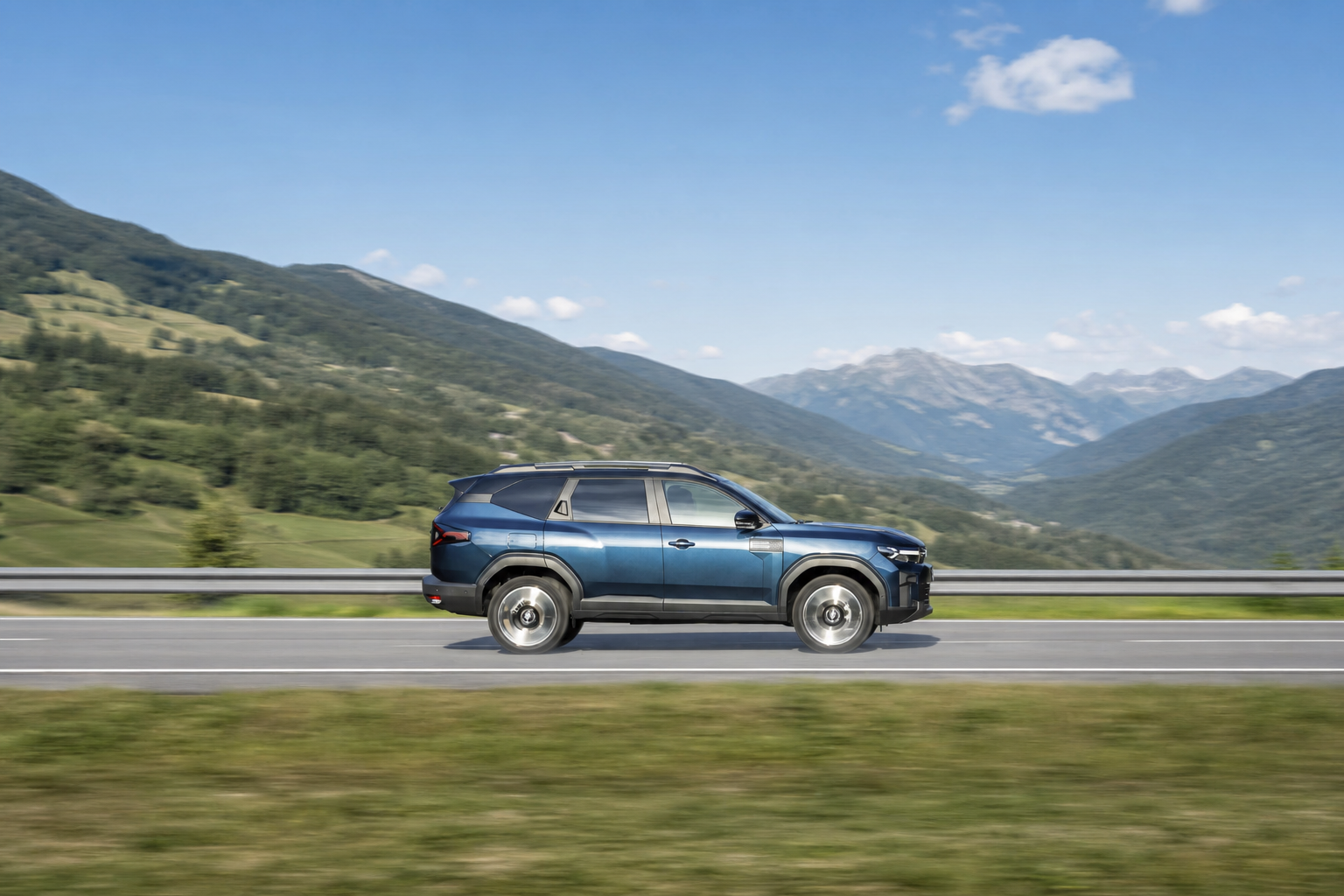
At high speeds, the hybrid system's advantage becomes smaller. Photo: Dacia / Adrien Cortesi.
Green NCAP provides more than just the holiday-trip result. The full Bigster test report shows how consumption changes with different temperatures and route types.
Scenario | Fuel consumption | What the result shows |
|---|---|---|
Official WLTP | 4.7 l/100 km | Baseline certification figure |
Warm weather | 4.3 l/100 km | Best laboratory scenario |
Short urban trip | 4.8 l/100 km | The hybrid is particularly efficient at lower speeds |
Mixed route at +2 °C | 5.1 l/100 km | A cold, but not freezing, real-world journey |
Loaded summer trip | 5.9 l/100 km | Four people, luggage, air conditioning, mostly highway driving |
Winter cycle, warm start | 5.2 l/100 km | The engine and cabin are already warmed up |
Winter cycle, cold start at −7 °C | 7.2 l/100 km | Warming up significantly increases fuel consumption |
High-speed highway | 7.3 l/100 km | High speed reduces the hybrid's advantage |
Why Town Driving Was More Economical Than Highway Driving
At lower speeds, the hybrid uses the electric motor more often and recovers some energy during deceleration. On motorways, there are fewer braking events, while aerodynamic drag rises quickly with speed. That is why 4.8 l/100 km on a short urban trip and 7.3 l/100 km in a high-speed test are not contradictory: the powertrain is operating under different conditions.
What Changes in Winter
A cold start at −7 °C increased fuel consumption to 7.2 l/100 km. Fuel is used not only to move the vehicle but also to warm up the powertrain and cabin. Once the vehicle was warm, the figure fell to 5.2 l/100 km. Green NCAP also rated cabin heating speed as weak, although it considered the insulation acceptable. For owners, this means that short winter trips will be less economical than longer journeys in a vehicle that is already warmed up.
Why the Environmental Rating Was 3.5 Stars
The Bigster received a score of 63% and 3.5 stars from Green NCAP. That is a strong result for a large petrol crossover: the organization highlighted effective control of pollutants, the tested vehicle's moderate mass of 1436 kg and the hybrid system's efficient operation.
However, its greenhouse-gas score was 4.6 out of 10. The reason is straightforward: even with low fuel consumption, a petrol engine emits CO₂, and the methodology considers the vehicle's impact throughout its life cycle. Low fuel consumption improves the overall result, but it does not make a petrol hybrid a zero-emission vehicle.
What the Result Means for Buyers
In mixed driving without severe frost, fuel consumption of around 5–6 l/100 km looks realistic based on Green NCAP's data.
On a high-speed highway, it is more sensible to plan for consumption closer to 7 l/100 km, especially with a full load.
In cold weather, short trips noticeably increase fuel consumption because of the energy required for warm-up.
The 847 km figure can help with initial route planning, but it should not be treated as a guaranteed distance between fuel stops.
Practical takeaway: the Bigster Hybrid shows its efficiency in town and mixed driving, while at high speeds its fuel consumption approaches that of a conventional petrol crossover. For a long journey, it is safer to allow for a reserve and avoid planning the route around the theoretical distance available from completely emptying the tank.