 EN
EN

Frequently asked questions
Carriage builders already had expertise in wooden bodies, seats, wheels, axles, brakes, springs, and steering mechanisms. Using existing designs, skills, and supply chains was easier than creating an entirely new vehicle from the ground up.
No. The 1865 Locomotives Act applied mainly to heavy road locomotives and other mechanically powered vehicles before small gasoline cars became common. Modern retellings often incorrectly suggest that every early family car had to be preceded by someone carrying a red flag.
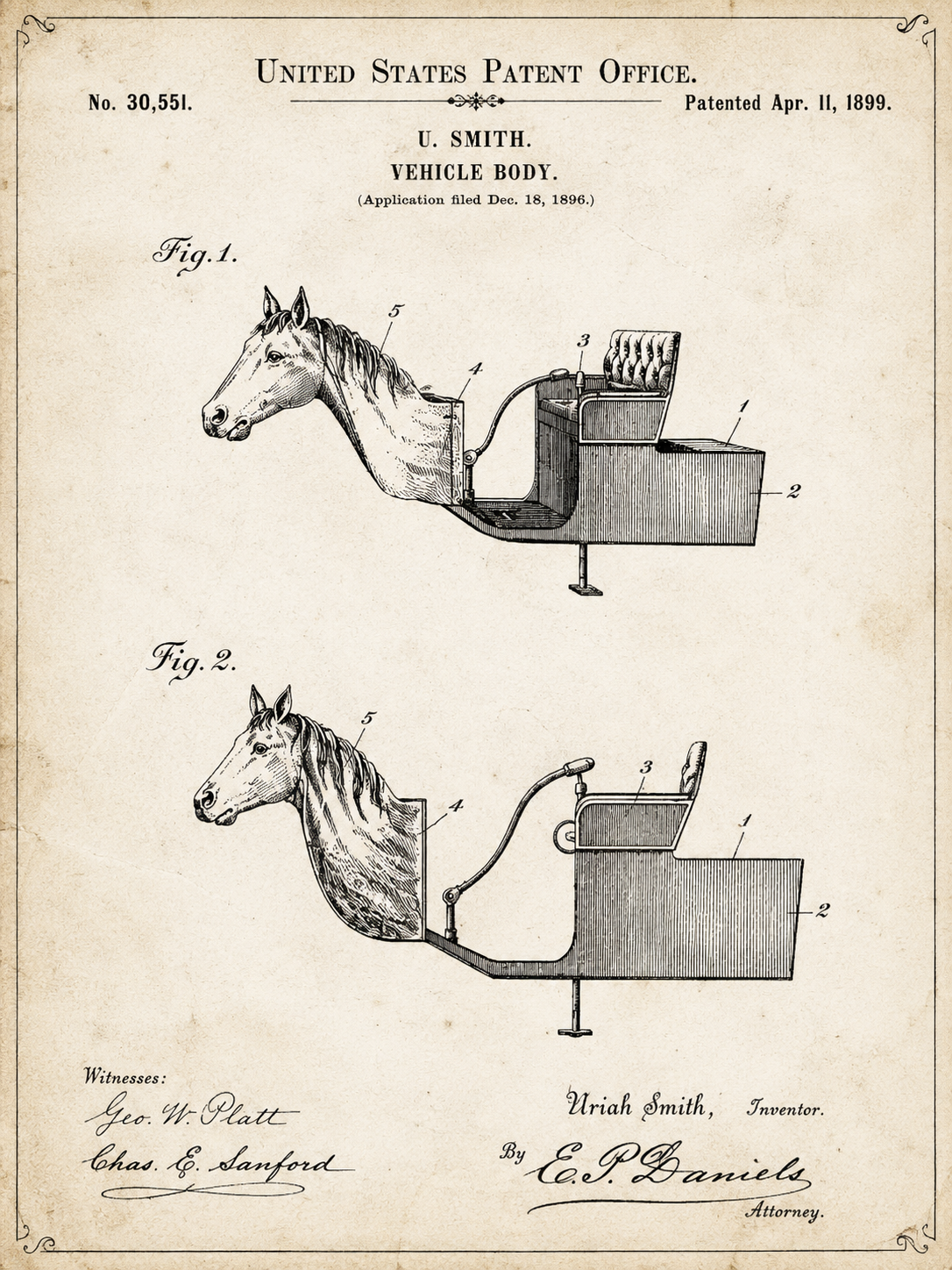
The surviving 1899 design patent by Uriah Smith shows a motor-vehicle body with a large horse’s head attached to the front. The patent does not establish that the vehicle was built, sold, or driven, or that the head was intended to reassure horses or contain a fuel tank.
The first cars did not look like the future. They looked like the past—because the past was terrified of them.
On a quiet road in Massachusetts, a family saw the future coming and climbed over a stone wall.
Years later, an elderly woman remembered the day the first automobile appeared on Lowell Road in Concord. Her father rushed into the house and called everyone outside to see the strange new “horseless carriage.” On another day, while the family was traveling in a real horse-drawn carriage, he spotted an automobile approaching. He made everyone get out, climb over a stone wall, and wait while he held the horse. (Source: tile.loc.gov)
That small scene contains the entire early history of the automobile.
There was the machine, noisy and unfamiliar. There was the horse, frightened by something that moved without muscles, hooves, or visible life. And there were the humans, fascinated by the invention but not yet sure whether it belonged on the road.
Today, cars feel inevitable. Their shape, controls, roads, fuel stations, traffic lights, licenses, and parking spaces are so deeply embedded in modern life that it is difficult to imagine a world that had not yet made room for them.
But the automobile did not simply arrive and replace the horse.
It had to imitate the carriage, negotiate with the horse, survive hostile laws, overcome terrible roads, and persuade society that a machine once nicknamed the “devil wagon” could become an ordinary part of everyday life.
And yes—at one point, an inventor really did patent a motor vehicle with a fake horse’s head attached to the front.
The truth, however, is even stranger than the legend.
The Automobile Arrived Wearing the Clothes of the Past
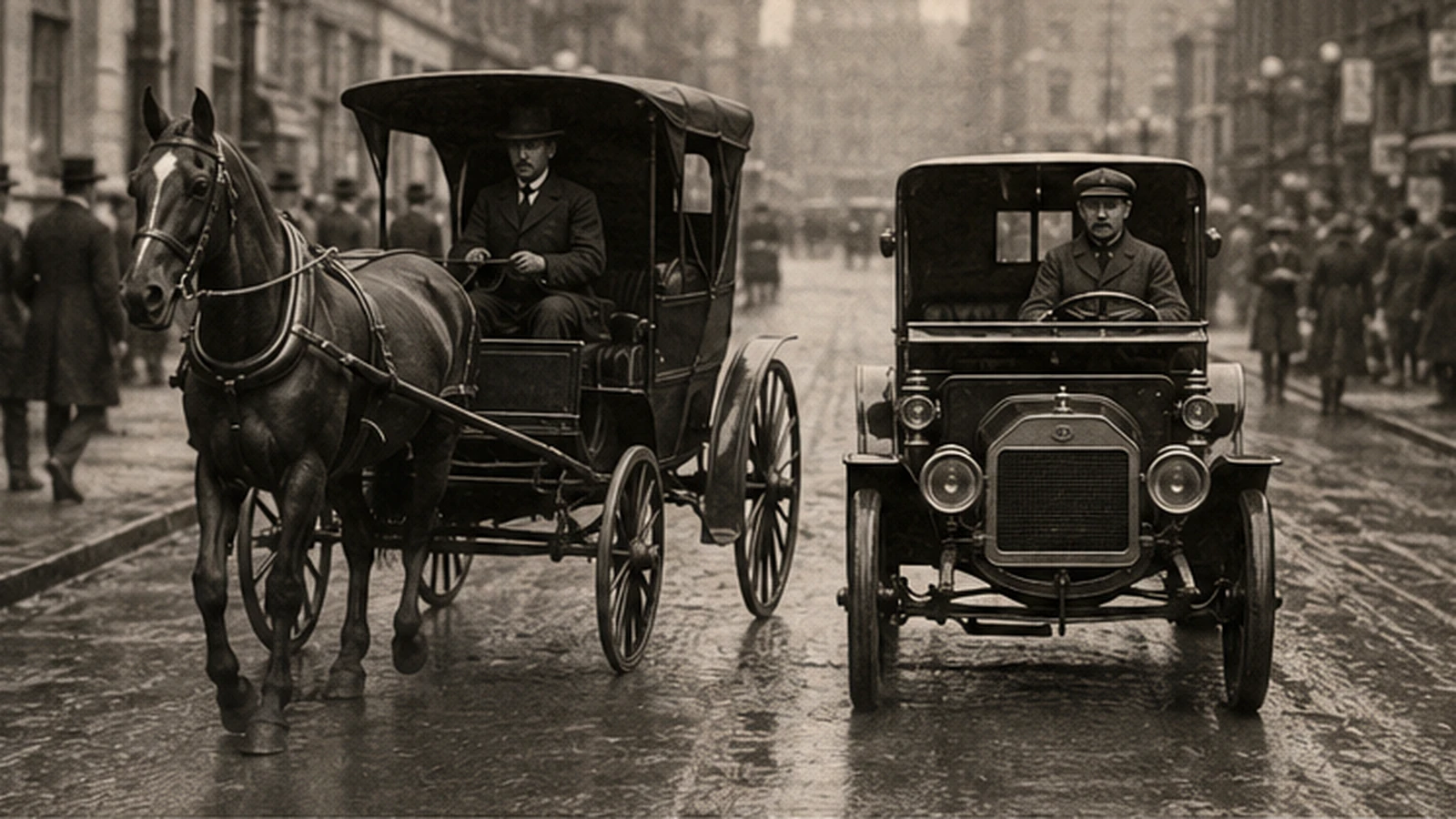
The first cars were not sleek visions of a mechanical future. Many looked like someone had removed the horse from a carriage and placed an engine underneath the seat.
That was not an accident.
The world already had a sophisticated carriage industry. Craftsmen knew how to build wooden bodies, seats, roofs, wheels, axles, brakes, springs, and steering mechanisms. Building a completely new vehicle from the ground up would have required new factories, new skills, and new supply chains.
It was far easier to begin with what already existed.
The earliest automobile manufacturers often came from the carriage business, the bicycle industry, machine shops, and metalworking trades. The Smithsonian notes that the first American carmakers included carriage builders, bicycle makers, machinists, and metalworkers—the people who already understood wheels, lightweight frames, chains, bearings, and mechanical movement. (Source: National Museum of American History)
Henry Ford’s first gasoline-powered vehicle, the 1896 Quadricycle, made this ancestry almost comically obvious. It used a simple metal frame, a leather belt, a chain drive - and an ordinary buggy seat.
The early automobile was therefore not one invention but a marriage of existing technologies:
It had the body of a carriage, the bones of a bicycle, and the mechanical heart of an engine.
Even the language looked backward. People did not initially know what to call the new machine. “Automobile” had not yet become universal, so the most intuitive name was simply horseless carriage.
The name described both what the machine was and what society was struggling to understand: a carriage from which the most important part had mysteriously disappeared.
There Was No Single Moment When “The Car” Was Invented
The automobile has no single, universally agreed-upon inventor because different machines achieved different “firsts.”
Steam-powered road vehicles existed long before practical gasoline cars. Electric vehicles appeared early as well. Engineers in several countries experimented with self-propelled transportation, often independently.
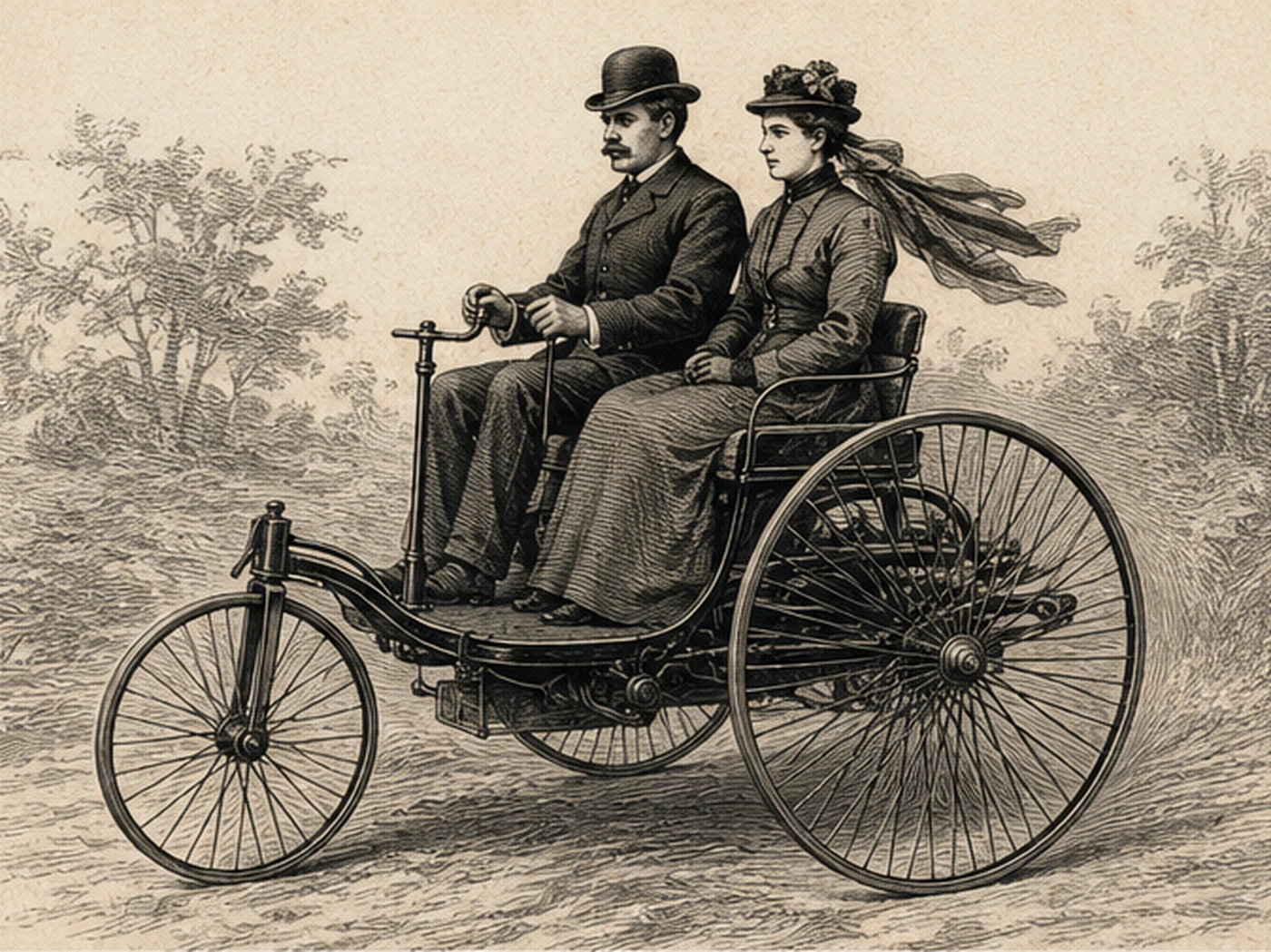
But Karl Benz’s three-wheeled Patent Motor Car occupies a special place in the story because it was designed as an integrated motor vehicle rather than simply as an old carriage with a motor added later.
On January 29, 1886, Benz applied for patent number 37435 for a “vehicle powered by a gas engine.” Newspapers reported its first public outing later that year. Its engine, frame, transmission, and steering were conceived as parts of one mechanical system.
That distinction mattered.
A motorized carriage still belonged intellectually to the age of the horse. Benz’s machine suggested something different: an entirely new category of vehicle.
But inventing a machine was not the same as proving that ordinary people could use it.
That task fell, famously, to Benz’s wife.
In 1888, Bertha Benz took an improved version of the vehicle on a journey from Mannheim to Pforzheim with her two sons. Including the return, the trip covered approximately 180 kilometers. It demonstrated that an automobile could do more than circle a workshop or entertain spectators—it could carry people over meaningful distances.
Bertha’s journey was part road trip, part engineering test, and part publicity campaign.
It also revealed a truth that would define the next several decades: the invention itself was only the beginning. A useful automobile also required fuel, repairs, reliable brakes, suitable roads, understandable controls, and a public willing to tolerate it.
In America, the Car Began as a Spectacle
Early American automobiles were less like ordinary consumer products and more like mechanical wonders.
They appeared at exhibitions, races, fairs, and even circuses. People gathered to watch them in the same spirit that they might watch a daring acrobat or an exotic animal.
The Duryea brothers helped change that.
Charles and Frank Duryea had connections to the bicycle business and became interested in the automobile after reading about Karl Benz’s work in Germany. Their early experiments eventually produced a successful gasoline-powered vehicle, and in 1896 the Duryea Motor Wagon Company built 13 identical automobiles. That tiny production run is widely regarded as the first series production of automobiles in the United States.
Thirteen cars may sound insignificant today. But the important word was not thirteen. It was identical.
Earlier inventors typically built one machine at a time. Each was an experiment, a prototype, or a custom creation. The Duryeas were beginning to treat the automobile as a repeatable product.
The transformation had started:
curiosity → invention → product → industry
Yet the road ahead still belonged overwhelmingly to horses.
The Real Conflict Was Not “Humans Versus Technology”
Stories about early automobiles are often told as a simple struggle between enlightened inventors and superstitious villagers.
Reality was more complicated.
People had rational reasons to fear early cars.
The machines could be loud, smoky, unreliable, and difficult to control. Roads had no lanes designed for automobiles, drivers had little or no formal training, and pedestrians were accustomed to traffic moving at the speed of animals.
Most importantly, automobiles frightened horses.
A horse was not merely an outdated form of transportation. It was a powerful living animal capable of panic. A sudden noise, burst of steam, unfamiliar smell, or fast-moving machine could cause it to bolt. A frightened horse might overturn a carriage, throw a rider, collide with another vehicle, or drag passengers down the road.
Early traffic rules were therefore written not only to control machines but to protect the animal-powered transportation system that already existed.
The first motorists were entering a road culture in which the horse still had priority.
Yes, Newspapers Really Called Cars “Devil Wagons”
The phrase devil wagon was not invented by modern social media.
It appeared in American newspapers during the early 1900s. Library of Congress archives contain examples of automobiles being called “devil wagons,” “red devil wagons,” and even, in one especially vivid description, an “odoriferous devil wagon.”
But the phrase requires context.
Its appearance does not prove that Americans generally believed cars were literally satanic. Newspaper writers loved dramatic language, jokes, exaggeration, and colorful nicknames. “Devil wagon” could express annoyance, ridicule, fascination, or hostility without implying a serious religious conviction.
It was a useful name for a machine that seemed almost unnaturally alive.
It roared without lungs.
It moved without legs.
It appeared to consume fire.
And unlike a horse, it did not respond to shouted commands from anyone standing in its path.
To people encountering one for the first time, the automobile was not simply a faster carriage. It was a violation of the familiar relationship between movement and life.
When the Future Was Required to Walk Behind a Red Flag
The most famous attempt to control self-propelled vehicles occurred in Britain.
The Locomotives Act of 1865 required at least three people to operate certain mechanically powered road vehicles. One person had to walk no less than 60 yards ahead, carrying a red flag, warning riders and drivers of horses, signaling when the machine should stop, and helping horse-drawn traffic pass safely. The law also required the locomotive to stop when signaled by someone responsible for a horse.
Its speed limits were almost absurd by modern standards: no more than four miles per hour on ordinary roads and two miles per hour through a city, town, or village.
Imagine the scene!
A machine had been created to move without an animal - but the law forced a human being to walk in front of it.
The future was legally required to travel at the pace of the past.
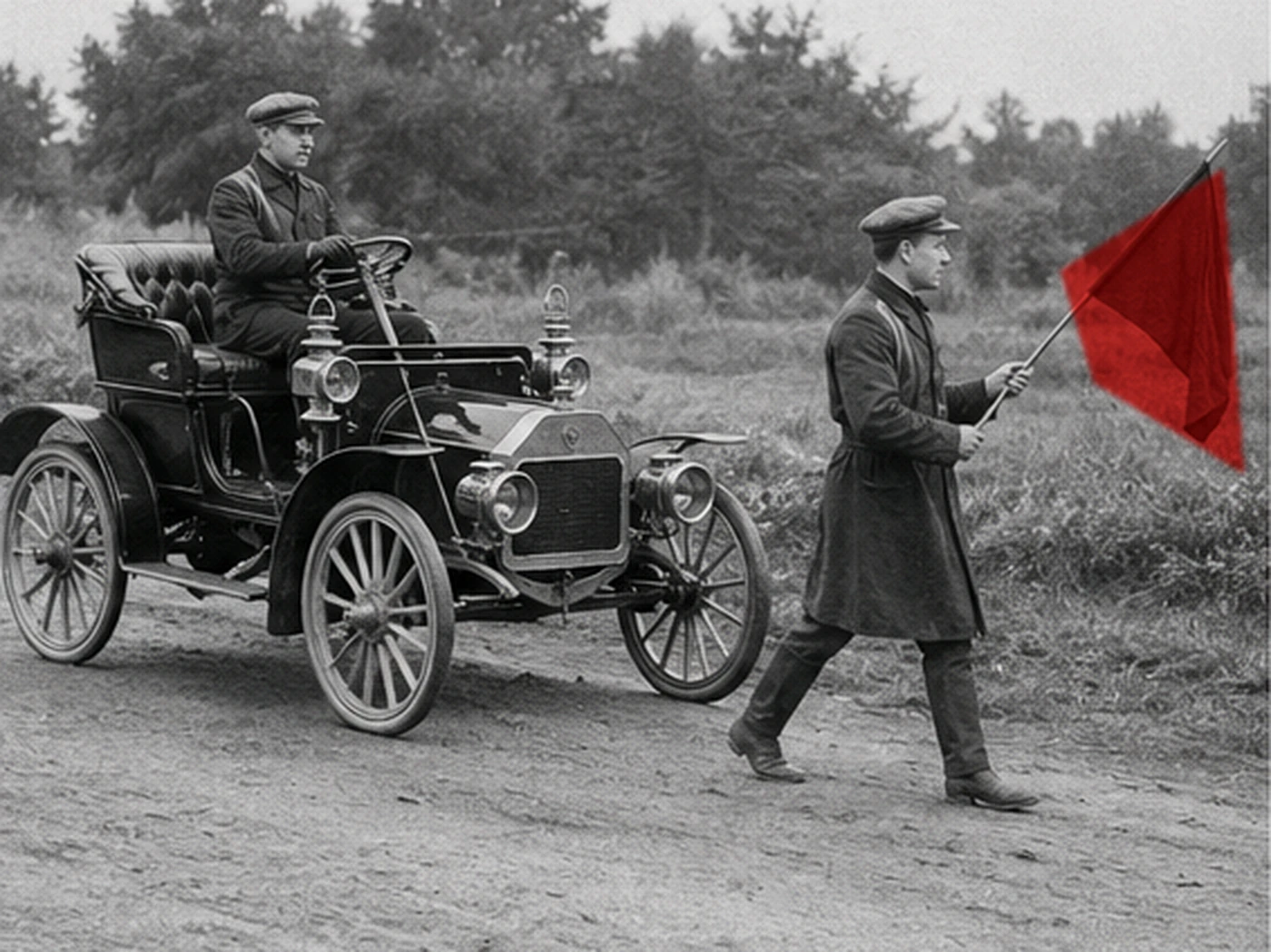
There is, however, an important historical correction. The 1865 law was created before small gasoline automobiles became common and was aimed largely at heavy road locomotives and other mechanically powered vehicles. Modern retellings often compress several decades of transportation history and make it sound as though every early family car was followed by a man waving a flag.
That is not accurate.
But the red-flag law was real, and its logic was unmistakable: mechanical vehicles could use the road only if they did not disrupt the horse-powered world around them.
America Had Restrictions Too - But Not One Nationwide Village Ban
The United States never had a single national law forbidding automobiles from entering every village.
Instead, states and local communities created their own rules. Drivers could be required to slow down near horses, stop when animals appeared frightened, obey extremely low speed limits, or avoid certain places altogether.
Connecticut’s 1901 motor-vehicle law set speed limits of 12 miles per hour in cities and 15 miles per hour elsewhere. It also required motorists to slow when meeting horses and to stop when a horse appeared frightened.
Some communities went further.
When the first automobile appeared on Mackinac Island, Michigan, in 1898, local residents decided they did not want it. The village council banned automobiles from city streets. In 1901, the park commission extended the restriction to the park that covered much of the island.
Mackinac’s response was not merely fear of a new machine. The island’s economy, atmosphere, and social identity were deeply connected to horses and carriages. Automobiles threatened not only safety but a way of life.
That local ban became one of the rare cases in which the horse did not simply lose the transportation revolution.
On Mackinac Island, the horse kept the road...
Then Someone Put a Fake Horse on the Front of a Car
This is the part of the story that sounds too perfect to be true.
On April 11, 1899, Uriah Smith of Battle Creek, Michigan, received United States design patent number 30,551 for a motor-vehicle body.
The drawings show a box-like automobile with the head and neck of a horse projecting from the front.
Not a small hood ornament.
Not a decorative emblem.
A large, life-like horse’s head extending ahead of the vehicle as though an invisible animal were pulling it.
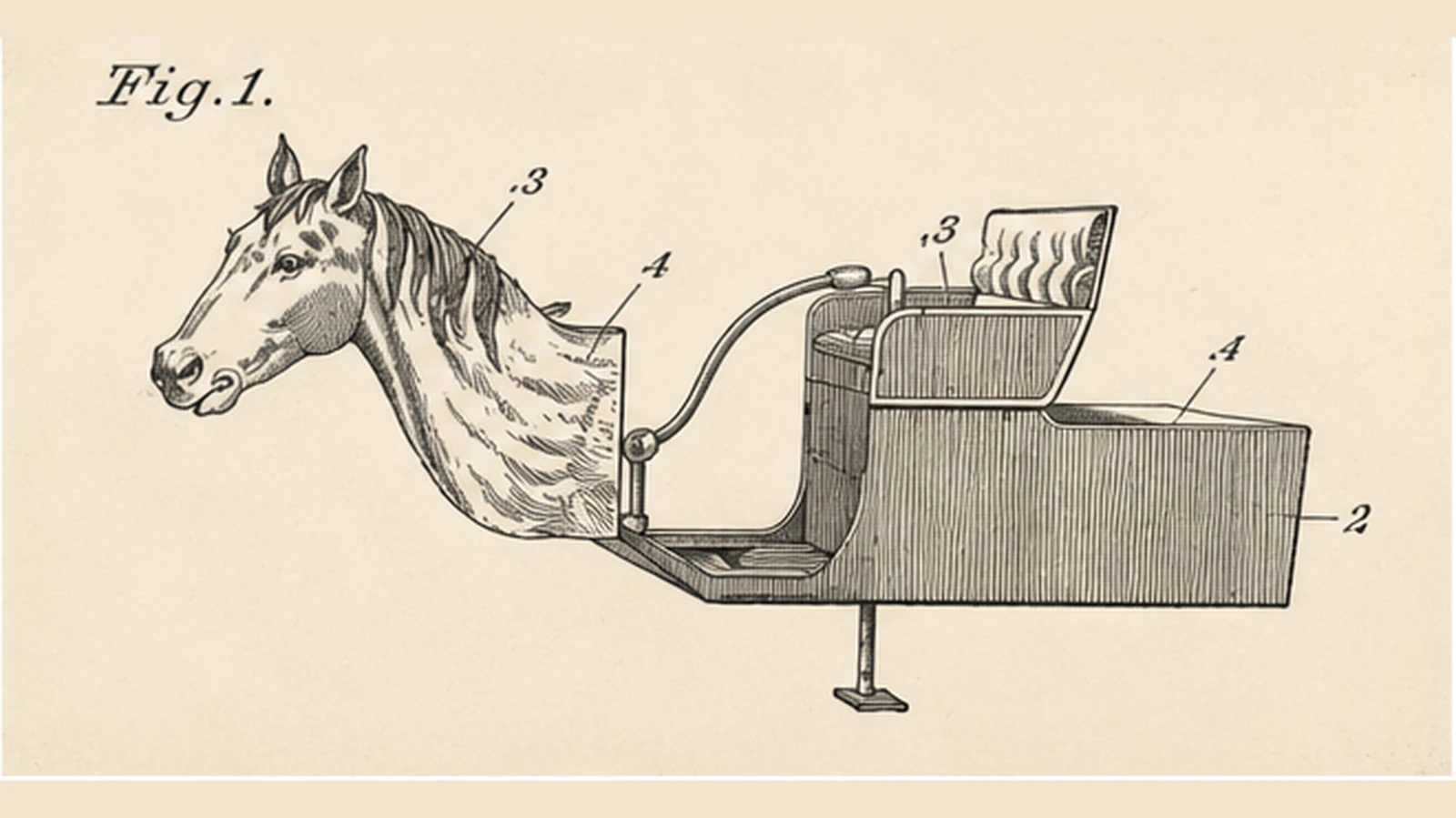
The patent describes a forward-projecting horse figure whose neck curves into the body of the motor vehicle. Smith called the design both “useful” and “ornamental.”
This extraordinary design is now frequently described online as the Horsey Horseless. According to the popular version of the story, the artificial horse was supposed to reassure real horses by making the automobile appear familiar. Some retellings add that the hollow head contained a fuel tank.
The surviving patent does not say any of that.
It does not explain that the horse’s head was intended to deceive animals. It does not call the machine the Horsey Horseless. It does not mention a fuel tank inside the head. And a design patent alone does not prove that a functional vehicle was ever manufactured, sold, or driven on a public road. (See also: Google Patents)
What the patent proves is narrower—and in some ways more fascinating.
At least one inventor believed that a motor vehicle could be made more acceptable, useful, or attractive by giving it the visual identity of the animal it was replacing.
The design captures a recurring pattern in technological history:
When a new invention feels too unfamiliar, people often disguise it as the old world.
The first digital cameras imitated the shape of film cameras. Early electronic books displayed page-turning animations. Smartphone icons represented paper envelopes, physical calendars, telephone handsets, and mechanical clocks.
And in 1899, someone imagined an automobile that still appeared to have a horse.
How the Car Finally Stopped Being a Carriage?
The automobile did not acquire its modern form immediately.
During the 1890s and early 1900s, manufacturers experimented with nearly everything:
three wheels or four;
steering tillers or steering wheels;
engines in the front, middle, or rear;
chain drive or shaft drive;
open or enclosed bodies;
steam, electricity, or gasoline.
There was no certainty that gasoline would win.
Electric cars were quiet, clean, and easy to start. They were particularly practical for short urban journeys. But their batteries were heavy, their range was limited, and rural areas often lacked electricity for recharging.
Steam cars could be fast and powerful, but they were more complicated to operate.
Gasoline cars were noisy and unpleasant, yet they could travel farther between fuel stops. Continuous improvements in ignition, carburetion, throttling, and power-to-weight ratio made them increasingly practical. Electric starters and electric lights later gave gasoline vehicles some of the convenience that electric cars had offered from the beginning. (Read also: National Museum of American History)
By 1901, the front-engine, shaft-driven, internal-combustion layout had appeared. By approximately 1910, it had become the overwhelming choice of motorists. Steam and electric passenger cars largely disappeared from the mainstream market during the 1920s.
The car’s appearance changed with its mechanics.
The driver moved from a position resembling a carriage operator’s seat into the body of the vehicle. Steering wheels replaced many tillers. Engines moved forward. Radiators became part of the machine’s face. Metal gradually replaced wood. Closed bodies protected passengers from rain, cold, mud, and dust—and became easier to mass-produce once manufacturers adopted metal construction.
The automobile was no longer a carriage missing its horse.
It had become recognizably a car.
The Machine Did Not Adapt to the World Forever. Eventually, the World Adapted to the Machine.
Early automobiles had to survive roads created for hooves, wagon wheels, and local travel.
Rural roads were often little more than dirt tracks. Rain turned them into mud; dry weather covered travelers in dust. In 1904, only about one-sixth of rural public roads in the United States had any kind of surface treatment. Early cars were built high partly to cope with these conditions.
When motorists became trapped in mud, bystanders had a favorite insult:
“Get a horse!”
The phrase was common enough to be preserved by the Smithsonian in its history of early American roads.
At first, the car had to adapt to the road.
Then car owners began demanding that the road adapt to the car.
The Good Roads movement had originally received major support from bicyclists, but automobiles transformed road construction into a national political issue. Asphalt, concrete, grading equipment, public funding, gasoline taxes, and vehicle fees helped produce roads designed for faster and heavier traffic. Federal involvement accelerated after 1916.
The transformation extended far beyond pavement.
Governments had to decide who could operate a car, how vehicles would be identified, where they could travel, and who would be responsible after a collision. New York became the first state to register automobiles in 1901. By 1918, every state required license plates, though driver testing developed much more slowly.
Cities added traffic signals, one-way streets, parking rules, speed limits, and larger police departments.
The automobile did not merely occupy existing space.
It forced society to invent an entirely new system around it.
Ford Did Not Invent the Car. He Made It Difficult to Live Without One.
By the beginning of the twentieth century, hundreds of American companies were producing gasoline, steam, and electric vehicles, often in very small numbers. Most would eventually disappear.
The decisive change came when automobiles stopped being individually crafted machines for wealthy enthusiasts and became mass-produced consumer goods.
Ford’s Model T, manufactured from 1908 to 1927, was rugged, relatively simple, and designed for production in enormous quantities. Ford and his engineers developed manufacturing methods that dramatically reduced assembly time and cost.
More than 15 million Model Ts were produced, while the price fell from approximately $850 to as little as $260.
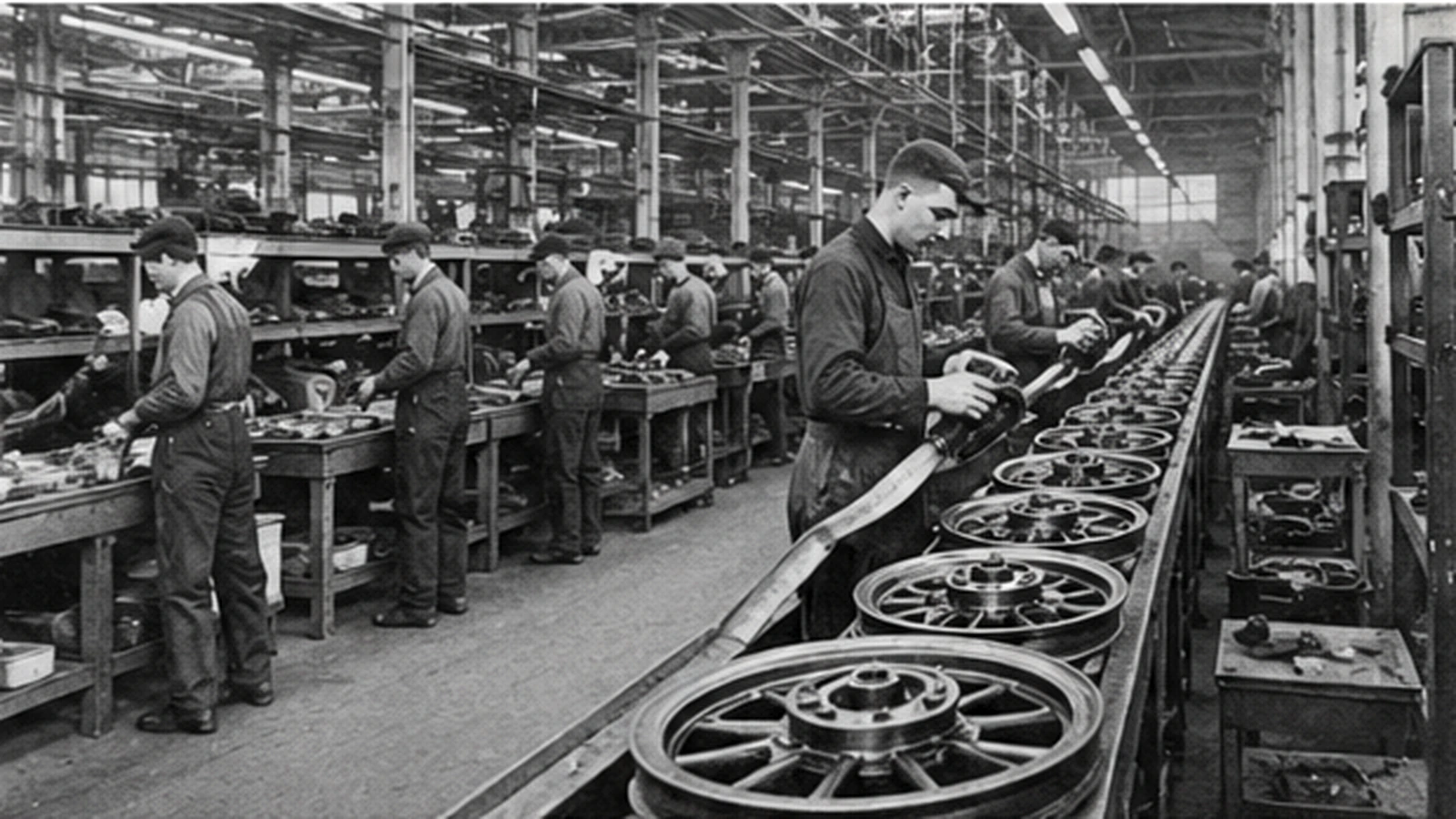
This changed the social argument around the automobile.
A rare machine could be dismissed as a rich person’s toy.
A machine owned by your neighbor, your doctor, your shopkeeper, and eventually your own family could not.
As ownership spread, the automobile became more useful because the world around it became more automobile-friendly. More cars created demand for better roads. Better roads made cars more valuable. More motorists supported fuel stations and repair shops. That infrastructure made ownership easier, which created still more motorists.
The automobile became part of a self-reinforcing system.
It did not defeat the horse in a single dramatic confrontation.
It made the horse less necessary, mile by mile.
The Horse Did Not Disappear Overnight
Even after automobiles began transforming American life, horses and motor vehicles shared the roads for decades.
In 1926—well into the automobile era - American manufacturers still produced more than 200,000 new wagons, and millions remained in use across the country.
The transition was uneven.
A wealthy urban household might own an automobile while a farmer continued relying on horses. A delivery company might use electric trucks in the city while animal-drawn wagons remained practical elsewhere. A town could have automobiles, bicycles, streetcars, pedestrians, and horse-drawn traffic all competing for the same road.
The so-called “death of the carriage” was not an event.
It was a long migration.
Old skills moved into new industries. Carriage builders became automobile body makers. Bicycle mechanics repaired engines. Blacksmiths became early auto mechanics. Stables became garages. Feed stores gave way to fuel stations. Roads built for hooves were widened and paved for tires.
Even the language migrated.
For years, cars retained carriage terms such as coach, coupe, cab, dashboard, and body. The horse vanished from the front of the vehicle, but the vocabulary of the carriage remained inside it.
What Is True - and What Is Internet Folklore?
True: Early automobiles were widely called “horseless carriages.”
True: American newspapers sometimes used nicknames such as “devil wagon.”
True: Mechanically powered vehicles were subjected to extremely restrictive laws, including Britain’s famous red-flag requirement.
True: American states and towns created rules requiring motorists to slow or stop around horses.
True: Mackinac Island banned automobiles in 1898, with a broader park restriction following in 1901.
True: Uriah Smith received an 1899 patent showing a motor vehicle with a large horse’s head attached to the front.
Not established: That most Americans believed automobiles were literally demonic.
False: That one national law prevented cars from entering every American village.
Not established: That Smith’s horse-headed vehicle was built, sold, or driven.
False—or at least unsupported: That motorists commonly attached fake horses to their cars so society would accept them.
The legend exaggerates the scale, but not the strangeness of the era.
The Future Rarely Looks Like the Future at First
The automobile’s greatest achievement was not simply replacing animal power with mechanical power.
It changed the meaning of distance.
It altered the shape of cities, the location of homes, the design of roads, the rhythms of work, the possibilities of travel, and the relationship between individuals and place.
But before it could do any of that, it had to pass through an awkward stage in which nobody knew exactly what it was.
Was it a carriage?
A locomotive?
A dangerous toy?
A luxury product?
A public nuisance?
A machine that should be preceded by a pedestrian?
Or a mechanical animal that might become less frightening if someone gave it a horse’s face?
The answer emerged slowly.
The automobile became a car only when it stopped being judged by the standards of the carriage—and when society began rebuilding itself around the machine rather than forcing the machine to behave like a horse.
That may be the most enduring lesson of the horseless-carriage era.
New technologies rarely enter the world in their final form. They arrive noisy, expensive, unreliable, and culturally confusing. We name them after what they replace. We force them to imitate familiar objects. We regulate them using rules designed for an older world. We laugh at them, fear them, and occasionally attach fake horses to them.
Then, almost without noticing, we reorganize everyday life around them.
And one day, the invention that once seemed unnatural becomes so ordinary that the old world is difficult to imagine.
The automobile did not conquer the horse by pretending to be more powerful. It conquered the horse by making an entire society forget that the horse had once been necessary.